
Excellent food begins long before the pan sizzles. Your hands, your blade, and the way they dance together in an almost meditative pattern begin it. That beat is a daily practice in the Hashmi Cuisine kitchens. The unobtrusive basis of every elegant dish brought to the table is accurate cuts, deliberate motions, and clean technique. Though professional cooks make it seem easy, every home cook may develop the same assurance. Good knife technique lets you cut more rapidly, perform more neatly, and prepare more safely, thereby preserving the natural texture and beauty of your food. View it as a sympathetic mentor, such as a chef bending over your shoulder to say, Hey, here’s how to make everything you do in the kitchen taste and feel better.
Why Knife Skills Matter More Than Most Home Cooks Realize
Many people are ignorant of precisely how much the knife depends on well before taste ever meets warmth. Excellent kitchen knife skills let you cut more consistently, therefore your ingredients cook more uniformly and avoid half-soft, half-undercooked bites from ruining a supper. Herb blackening and vegetable bruising are prevented by clean cutting. You waste less because you trim exactly what you need. And above all, proper kitchen knife skills actually keep you safer because you’re using controlled, predictable motions instead of forcing the blade through food. For chefs at Hashmi Cuisine, their cuts are crucial to the final flavor and the visual balance of the plate, not only technically. You’re aiming for that even within your own house.
Choosing the Right Knife for the Right Task
A lot of confidence simply comes from picking the right knife. You don’t need a huge collection, just a few reliable tools that work extremely well.
Chef’s Knife
Your most important knife for almost everything. You will be reaching for this blade about seventy to eighty percent of the time.
Paring Knife
Peeling, trimming, hulling strawberries, or creating tiny garnishes call for this little blade. This is the one you seize when accuracy is essential.
Serrated Knife
Good for anything with a rough exterior and a soft inner, including tomatoes, lemons, bread, and other fruits. The teeth help you chew gently without squashing food.
Boning Knife
Thin and slightly flexible, ideal for removing bones from poultry or trimming meat. Even home cooks who don’t butcher often will find it useful for more controlled cuts.
How to Hold a Knife Properly (The Chef’s Grip)
A knife works best when it becomes an extension of your hand. The chef’s pinch grip is the foundation. Hold the handle with your whole fist, not twisting your other fingers around it, and grip the blade with your thumb and index finger just above the handle. Your movements become more calculated as your wrist stays straight and the blade remains stationary. Once you adjust to this grip, you will see fewer slips and less uncertainty. And honestly, your hands will feel more like a chef’s hands because this is how the teams at Hashmi Cuisine maintain precision during long service hours.
Mastering the Rock Chop Technique
The rock chop is the signature motion behind smooth, efficient cutting. Almost like a hinge, you keep the tip of your chef’s knife gently in contact with the board and raise and lower the heel of the knife in a swaying motion. The blade performs the tasks. Your guide hand progressively feeds components onto the knife’s path. Far safer than lifting the entire blade into the air every time, this method lets you gain speed without losing precision. That rhythmic chop-chop-chop found in professional kitchens, when cooks create almost hypnotic sensations, is the method you see.
The Slice, Not the Crush
If you had ever chopped them merely to see them darken and turn mushy, it was the method that was wrong, not the herbs. With a soft forward-and-down action, the knife slices across the food for a crisp cut. Crushing happens when you push straight down. Keeping cell walls intact in basil, parsley, mint, and other fragile greens especially helps to preserve color and taste. Because it keeps elements on the plate brilliant and fresh-looking, chefs at Hashmi Cuisine always make cutting their top goal while making garnishes or aromas.
Essential Cuts Every Cook Should Know
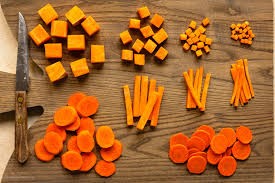
Regular cooking rests on essential cuts, which guarantee uniform cooking and chef-inspired meals. Dicing works great for soups, aromatic plants, and veggies in little, medium, and large sizes. Start with slabs, then sticks, and finally cut cubes uniformly. Julienne offers a quick-cooking texture and elegant, matchstick-like strands perfect for carrots, peppers, and other robust vegetables. Chiffonade works best for herbs or leafy vegetables; stack, roll, and cut into tiny ribbons for mint, parsley, or basil. By contrast, a batonnet produces thicker sticks suitable for grilled veggies or French fries; mincing yields tiny, uniform pieces of garlic, shallots, or herbs.
Using the guide hand, also known as the claw method, safeguards the fingertips and guarantees accurate, confident cuts across all these essential knife techniques.
Knife Safety Rules Home Cooks Often Forget
Though not complex, knife safety most often results from the omission of fundamentals.
Underneath, a damp towel will help to steady your cutting board.
Work on a clutter-free surface.
Never aim for a descending knife.
Keep knives in a block or on a magnetic strip.
And remember this always: a blunt knife is more deadly than a razor-sharp knife, for it makes you push harder.
Why a Sharp Knife Is a Safe Knife
There’s a big difference between sharpening and honing. Honing realigns the blade edge and should be done frequently. With metal, sharpening revives the edge; depending on use, it should be done often. Because a sharp blade allows a cleaner cut with less effort, the experts at Hashmi Cuisine sharpen their knives once a week with a combination of whetstones and honing rods. Performance will suffer even though you hone your blade before every home visit. A razor-sharp knife makes you push more.
FAQs
What knife should a beginner start with?
Because it performs most tasks comfortably and in control, a good-quality chef’s knife is the best starting point.
How often should I sharpen my kitchen knives?
While most home cooks may sharpen every few months, honing before each cooking session helps to maintain the edge in line.
Why do my herbs turn black when I cut them?
They’re likely being crushed instead of sliced; use a smooth gliding motion to keep herbs bright and fresh.
Conclusion
Excellent cuisine has silent energy behind it: kitchen knife skills. Learning to wield your knife confidently makes every dinner you create easier, faster, and much more appetizing. These are the same ideas that shape the wonderful flavors and beautiful displays at Hashmi Cuisine; employing a little of that skill in your home kitchen can improve even the simplest supper. If you ever want to taste how professional knife work transforms ingredients into elegant, memorable dishes, you may always enjoy the workmanship awaiting you at Hashmi Cuisine.
